Friday, January 21, 2022

History of the Erudites Part II: Everquest

At one time it was possible to follow the cultural and physical evolution of the races of Everquest across three games, EQOA set 500 years before EQ, EQ and EQ II which is set 500 years after EQ.  For most races there weren't particularly interesting changes from one game to the next, most of the changes relating to the quality of the character models available.  However in the erudites we can witness a profound set of physical changes as the race is slowly altered by their close association with magic.  There are also dramatic shifts the Erudite society during the 1000 years the games cover.  You can find Part I of this series here.

Erudites in the time of Everquest: civil war and the first cataclysm 

In the time of Everquest, we see the first clear signs that magical experiments are beginning to alter erudites on a genetic level.  While they still have hair, they gained noticeably larger foreheads than even the most naturally "five headed" of normal humans.  Presumably this reflects their brains beginning to expand, as their high starting intelligence (compared to most races in Everquest) begins to be due not only differences in cultural traditions and educational systems, but also differences in physical characteristics.   Always a tall and thin race of men, they are now starting to look not just regal but also a bit alien with their bulging craniums.

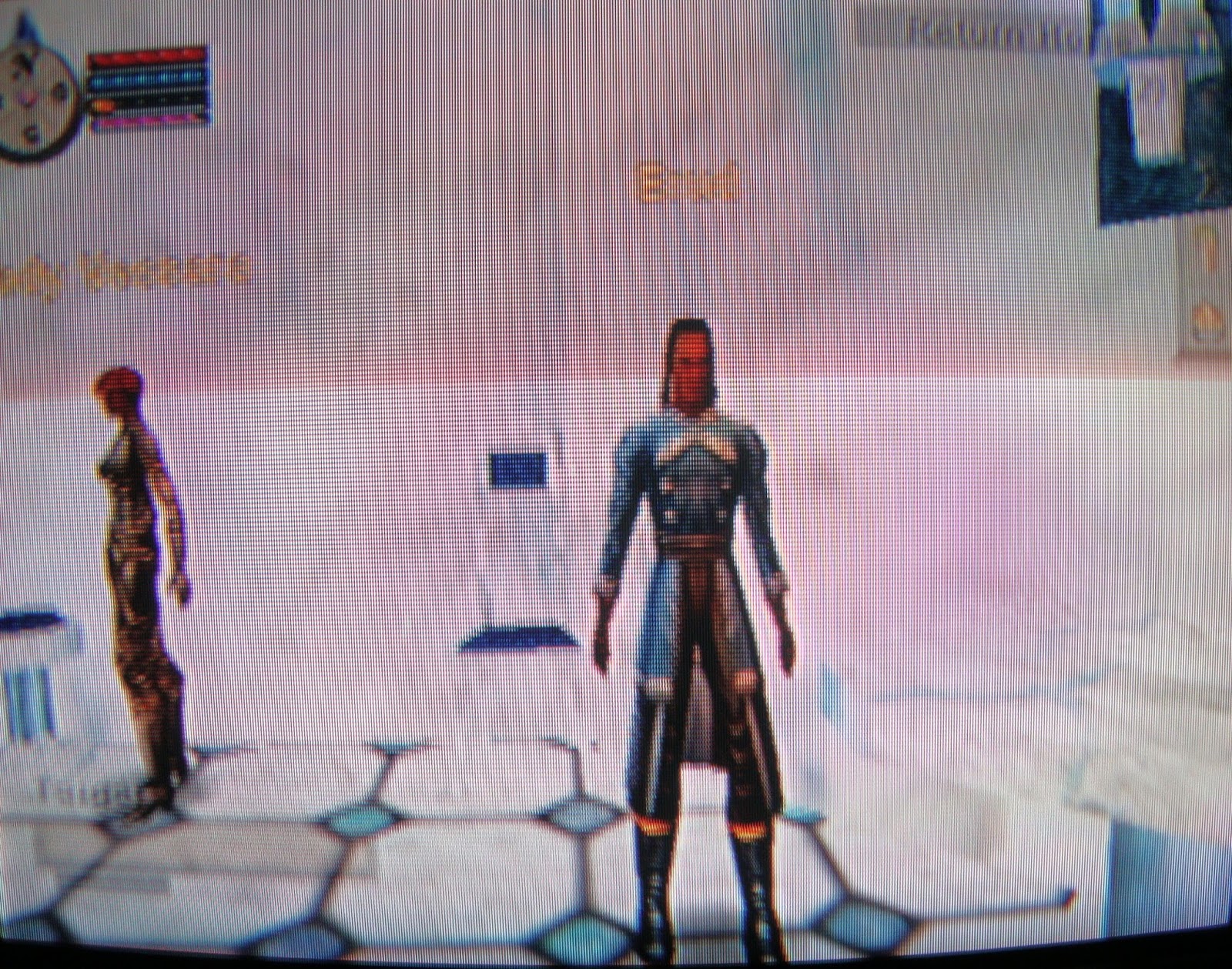
Erudites from the character selection screen in EQ.  Tall humans that are slender and dark skinned.  In this time period they are still fairly normal looking humans, save for their greatly expanded craniums.

In EQOA, high men started in the city of Highbourne, a city along the coast of Tunaria south of Quenyos.  The city seems to have been completely abandoned by the time of EQ.  It may have been somewhere in the modern Southern Plains of Karana, or it may have been swallowed when the much smaller lake Rathe, that appears on maps of EQOA , expanded into modern Lake Rathetear. However, the most interesting change since the time of EQOA is that there is now been a rift between the erudites that study most forms of magic and those that study necromancy.  

The part of their brains that seems to have expanded to most is the cerebrum, associated with higher brain functions such as reasoning, language and learning.  The 500 year gap that separates EQOA and EQ is not nearly long enough to have wrought such dramatic changes via organic evolution, representing perhaps 30 or 35 generations.  We can only assume that this rapid evolution represents the influence of magic, something that will become even more clear 500 years hence when we revisit erudites in the time of EQ II.

In the time of EQOA, players that studied all forms of magic lived in the same settlements.  The fact that one of the main NPCs that necromancers interact with in Highbourne at higher levels was a little hidden away hints that this may have been a somewhat uneasy alliance.  Nonetheless, High Men of all faiths and professions were still working towards common goals, and were part of the great crossing when the race began its migration to Odus from the mainland of Tunaria.   The settlement they founded on Odus, originally Arcadin, was renamed Erudin some time after the great leader Erud died.  During the time period of EQ this elegant city is where most erudites can be found, and where players of erudite Wizards, Enchanters, Magicians, Paladins and Clerics of most gods start.

Erudin, where erudites of most classes used to start.  An elegant city reflecting an enlightened people. Of course now mebers of all races and classes start in the neutral city of Crescent Reach by default.

However, players that choose to play a Necromancer, a Shadowknight, or a Cleric that worships Cazic-Thule are no longer welcome in Erudin with their brethren.  Instead they start in the city of Paineel or in the neutral city of Crescent Reach.  In fact, players from Paineel are so despised by other erudites that they are kill-on-sight to guards in Erudin.  This is also where the erudite lore starts to get really interesting.  According to multiple sources, the founding of Paineel was related to a civil war caused by erudites that recklessly pursued necromantic magic. 

The ruins of old Paineel.  Paineel is the city where erudite necromancers and shadowkights used to start.  I assume these are the ruins of an older settlement beneath the city.  I ended up here after trying to jump down to the city proper from the edge of the Hole.  Since the character I was taking screenshots with is not friendly enough with the local guards, none of them were willing to give him a copy of the key to the secret elevator leading there from Toxxulia Forest.  Getting around in EQ is often the opposite of convenient. Everquest is a game that still flies its oldschool MUD roots proudly, which I actually find delightful when I'm in the right mood for it.

The story (which you  read more of here) goes that an Erudite named Miragul was obsessed with dark magic and personal power.  Followers of Miragul visited the Dark Elf city of Neriak, and returned with knowledge of both necromancy and the god Cazic-Thule (the god of fear).  Miragul's followers concluded that Cazic-Thule was the strongest god, and the best way to serve him was through necromancy. When the high council of Erudin  discovered what they had been up to, it led to a civil war.  The followers of the high council  eventually won the war to all intents and purposes with a blast of magical power focused on the largest concentration of forces in Miragul's army.  So great was the power of this blast that it ejected part of Odus into space.*  Miragul's followers were presumed killed by the victorious inhabitants of Erudin.  However a few survived and founded a new hidden city, Paineel, deep within the crater created by the blast.  There they can be found to this day, in a city populated by more animated skeletal servants and guards than by live erudites.

 I find this story really fascinating, because I know that it isn't true. . . or is at least extremely misleading.  I have been to the past (EQOA), during the time of the great crossing.  At the time erudites already had a long history of necromancy, and necromancers worked alongside practitioners of every magical tradition.  Erud himself embraced followers studying all forms of magic, including necromancy, and worshipping any gods.  In the screenshot of him for my previous post, if I remember correctly I was even talking to him while playing a Shadowknight!  So what really happened? 

The famed library of Erud.  According to several sources, it is the largest and most famous library in all of Norrath, It's filled with merchants selling spells, and I presume in the launch era used to have one of the better selections available anywhere.  In the modern game, this function has been supplanted by the Plane of Knowledge.

I suspect that it was not the followers of Miragul that caused the rift, but an intolerant high council of Erudin that tried to outlaw necromancy, holding that only elemental, arcane and holy magic was fit for civilized society.  When erudite Shadowknights and Necromancers tried to protest these changes, their calls fell on deaf ears.  The eventual result was a civil war and a cataclysm.  

The cataclysm itself was probably the nearly inevitable result of a war between arcane and necromantic spellcasters.  Presumably in any prolonged conflict with necromancers, things soon start to go quite badly for the opposition.  Anyone that falls and leaves a body in either army during the fighting is raised from the dead and added to the ranks of the necromancers.  Perhaps desperate to end the battle in a way that wouldn't leave even more fodder for undead soldiers, the followers of the high council of Erudin resorted to a concentrated blast of pure magic.  However, they seem to have underestimated the power they harnessed, nearly cracking the planet asunder.  The explosion left an enormous crater, and the dust thrown up probably caused a period of global cooling (similar to volcanic winters) and famine from failed crops across Norrath.  Ironically, it was the practitioners of arcane magic that nearly destroyed all life on Norrath during the conflict, not the "evil" necromancers.

From the entrance of the crater leading to Paineel, you can see this intriguing structure separated from you across a chasm.  I am not sure whether it's part of Paineel or something else.  The crater formed by destructive magic during the erudite civil war is referred to as the Hole, though this chasm is only part of it (most of it, the Hole proper, is a zone connected to this one).

The story of Miragul's followers sneaking off to learn about necromancy from the sadistic Dark Elves is probably just propaganda written by the victors after the war.  But clearly there was a change in policy towards necromancy at some point.  So why the sudden change after hundreds of years of coexistence between all schools of magic in Highborn, Arcadin and later Erudin? Perhaps the followers of  Quellious, the goddess of peace, decided that they could no longer coexist beside followers of Cazic Thule.  Or perhaps the association between necromancy and sadistic and brutish races such as dark elves, ogres and trolls became an embarrassment to some faction that sought a closer relationship with students of arcane magic among the High Elves.  Or perhaps the followers of Miragul truly did do something abhorrent that triggered the war.  We will likely never know what really happened, since history is written by the victors and in this case they seem to be lying. 

A brand new level 2 Erudite Mage in the tutorial area, with his pet and a free mercenary (the later makes the modern game a lot easier solo experience than it was a decade ago). Erudites were always one of my favorite races for Magicians. They have high Int, so a deep mana pool, and they learn magical skills extremely quickly.  Of course in the modern game starting stats make little difference, because even a Troll or an Ogre is going to have capped Int. by the ripe old age of level 19 or so if they focus on it. However, at least in places like Project 1999 I would imagine it's still a consideration.

Regardless, by the time of EQ, the story of the evil Miragul and his followers causing the great war has become broadly accepted as truth.  Even the erudites that live in Paineel seem to believe it, and to revel in the fact that despite the best efforts of powerful foes they survived the cataclysm and have prospered in their own way.  However the test of erudite resilience is far from over.  Though the cataclysm was dramatic, even that planet shaking event will pale before the next disaster that erudites will contribute to.  

My next and final post in this series will be about erudites in the time of EQ II, 500 years in the future.  I originally was going to cover EQ and EQ II in this one.  However after I got done typing up the absolute bare minimum I wanted to say about erudites in the time of EQ, I had a full blog post. 

*This chunk of Odus it landed on Luclin carrying some Kerrans, a race of feline humanoids that lived on Odus before the high men arrived.  The descendants of these Kerrans later evolved into the Vah Shir.  Of course this is a vast oversimplification.  To read about what really happened to the Kerrans and the history of Erudite colonialism, see the first comment below from Bhagpuss.


Thursday, January 13, 2022

History of the Erudite Race I: Everquest Online Adventures

The Erudites are a humanoid race in the Everquest series of games.  It's actually one of the more original races in the game, with no direct analogues in fantasy fiction I am aware of, though they did borrow somewhat from Tolkien's Dunedain. By traveling through Everquest Online Adventures, Everquest, and Everquest II it once was possible to witness their evolution first hand, as they gradually evolved from regal but normal looking humans to a hairless and somewhat alien looking race. EQOA is no longer with us, but I took a bunch of screenshots of it the last few days it was up.*  And so I present the first post in a planned series on the history of Erudites across three games.

Erudites in the time of Everquest Online Adventures: the High Men

EQOA was set 500 years before the original EQ.  Several things were noticeably different.  For example the wood elves and high elves had not yet diverged into separate races, and many bits of geography mentioned only in lore in EQ were still around to be visited. Perhaps the most noticeable difference was the erudites. 

Male and Female Erudites from the character creation screen of EQOA. While they have prominent foreheads, they also still appear quite human. 
  
Originally the Erudites of all professions lived together in one city, Highbourne, on the same continent as the other human cities, south of Quenyos on the coast.  They also referred to themselves as "High Men."  Though taller, thinner and darker skinned than most humans, they didn't really appear to be a distinct race from human at this time (at least not the the same degree as barbarians and humans, for example). If you looked around  Highbourne, you could stumble across this mysterious figure in a shrine: 

Duke Morthalis, a mysterious NPC in a part of the city of Highbourne that only Necromancers and Shadowknights were likely to go to.

I assume he granted class quests to erudite necromancers at higher levels than I ever made it to.  However, the presence of this somewhat secret NPC hinted at the rift that was to divide the erudite race in the future.  When EQOA first came out, high men were confined to the mainland.  However, if you went to the shore you could find boatbuilders talking about preparations for founding a new colony in lands to the west, over the sea. 

This stone greeted you when you first traveled to the new colony of Erudites, founded on the island of Odus.

The new landmass, the Island of Odus, was added with the first and only EQOA expansion: Frontiers. Erud was the leader of the high men in the time of EQOA.  The stretch of sea in between the mainland and Odus is referred to as Erud's Crossing in some later maps. Erud founded a colony on the island,  which he named Arcadin.  However, some time after his death the name of the city that sprung up from it was changed to Erudin in his honor.  Erud had such a profound impact on the cultural development of high men that members of the race were generally known as Erudites in later years, regardless of whether they lived in Erudin proper or other parts of Norrath. 

Erud, for whom the Erudites (i.e., followers of Erud) are named.

In the time of EQOA, you could talk to Erud by travelling to Arcadin.  If you had played the original Everquest, it was kind of that fantasy equivalent of getting to chat with George Washington.  When you talked to him, Erud gave the following speech:**

Behold you bear witness to the founding of Arcadin!

[Response: " What is Arcadin exactly?]

Now it is but a humble beginning, stone and wood slowly being fitted together to reveal the shadow of what is to come.  I have envisioned a great metropolis, one that will span for miles across the land and stretch upwards to the heavens.  It is here that we will give birth to the epicenter of enlightenment,  arcane mastery and discipline, and prosperity in peace. 

Enlightenment, prosperity, and peace. The are the elements upon which Arcadin is founded and destined to uphold.  And not just the people of Highbourne shall bask in the glory of this place. Nay, for this is our gift to the world. All beings who share a thirst for enlightenment and bear within their souls the pursuit of peace and mortal righteousness . . . it is them who are welcome as friend and citizen. She will hold them dear, for it is they who are her lifeblood and her pulse. 

This is my vision, this is our intent and it will be done for no being stands above the cause . . .And none who strive in parallel of her goal . . be them high man, elf, dwarf or man . . are beyond her reach.

As NPC speeches went in EQOA it was a heck of a long one.  For any kind of Everquest lore grognard, the whole encounter was also a guaranteed nerdgasm.  

High men had the highest starting Intelligence of any race in the EQOA. Intelligence determined the size your mana pool, and I believe also affected the chances that mobs would resist your spells.  Oddly, dexterity determined how much damage spells did.  Regardless, the high starting Int. made high men a good choice for wizards, magicians, necromancers and enchanters. They were also an interesting choice for a Shadowknight, the racial option that yielded the strongest possible spellcasting ability for the class.  

Magic was central to the culture of high men, an association so intimate that it eventually began to affect their physical evolution. High men were very much a neutral race in the time of EQOA, fully embracing all forms of magic. Practitioners of elemental magic, enchantments and illusions, as well as both holy and death magic, all lived together in several communities in western Norrath.  However, what started as different areas of intellectual interest soon became philosophical differences, and later led to real conflicts.  Eventually followers of the necromantic arts were banished from Erudin entirely.  
 
My next planned post is on Erudites, as the high men came to be known,  in the time of Everquest.  Though given my current spare time quota, I can't put a timetable on it!

*Apologies for the quality of these "screenshots", they are actually photos of my old CRT television.

**Yes, I did sit in front of my TV and transcribe the speech word for word.   


Sunday, November 28, 2021

Ragnarok Origin (Android) and Cowboy Beebop (Netflix)

As you may have guessed from my entire series on location based games, I have started to become somewhat enamored with modern portable games.  Both my phone and my Switch console have started to get a lot of use.  I especially like the switch because it instantly coverts to proper a video game console just by docking it in a little stand that sits behind my television.  It's like having a PS4 that you can take to bed with you.  

This week I have had a couple surprises, a game and a new television series both of which completely defied my initial impressions of them. 

Ragnarok Origin

Ragnarok Origin has been getting advertised to me a lot when I play other games on my Android phone.  Curious what a real MMO would play like on it, I decided to fire the game up.  While there are certainly the bones of a good game there, it is also currently an extremely frustrating experience.  

A screen shot from Ragnarok Origin, an Android MMO released at the beginning of November.

First the good.  The graphics are charming, if perhaps too cutesy.  The gameplay also works amazingly well on a tiny phone screen.  Combat in particular strikes exactly the right balance of being stripped down enough to work well with only a few buttons, but still deep enough to be entertaining.  You need to pick a loadout of up to five active abilities from everything you have access to, which makes for some fun strategic choices.  However even using a screen area the size of a few postage stamps, it's still very easy to select the abilities you want to use. 

I find the graphics overall charming, if a bit too cutesy.  The aesthetic seems aimed squarely at tweens and tweens-at-heart.  You can see the hotkeys used for combat in the lower right hand corner.  Basically five hotbar abilities, a button to target the nearest mob, and an attack button.  The controls work surprisingly well in a fight, giving enough options to be interesting but not so many that it's a struggle on a tiny screen.  Movement is a bit clunkier, and rotating the camera so you can see where you are going even worse (it's best not to do so at all if you can get away with it).

However, once you get over the surprise of a full featured MMO that looks good and plays well on your phone, the game starts to completely fall apart.  Having played MMOs since EQ in 1999, I consider myself a veteran of the genre.  However, I still find the game incredibly confusing.  The entire first hour of play is a tutorial taking you through what seems like a hundred systems, each of which you will only start to vaguely understand before being whisked off to learn about the next one.  By the time you get through it all, you are guaranteed to have forgotten half of what you were just introduced to.  There are simply too many advancement systems crammed into RO, and none of them are explained very well. 

The game is also confusing, and wants you to spend money more than any other android game I have tried.  I am not sure what half of the icons in the upper right do.  However almost all of them lead to a different way to spend money.  For example, one of them leads to a limited time "gift" that you have to pay $4.99 for.  That is literally all it does. What the butterfly wings are used for, how I got them or how I will get more when I used them up I have no idea whatsoever.

You often find yourself staring at a screen full of stats to allocate points to, and little guidance on where the best place to put them, or a lot of skills to pick from that are hard to evaluate until you try and use them.  You can of course just have the game make all the choices for you, but at that point it feels like the game is playing itself.  There is also gear to be leveled up.  Not only does it quickly become very expensive to do so, there is always the chance that an item you are trying to upgrade will break and become completely useless.  The more powerful the item you are trying to upgrade the greater the risk of this happening, and of course there are ways to get around all of this in the cash shop.  For some activities it's also not all that optional.  Rumor has it that to be competitive in PvP spending hundreds of dollars to upgrade your gear is pretty much mandatory.  The game is also quite eager to charge you real cash for respecs if the confusing series of advancement systems leads you to screw anything up.

The advancement systems are surprisingly deep, but also extremely poorly explained.  Most of the time it's better to let the game allocate points for you than to try and make sense of things yourself.  The game tells you what a point in each stat literally does for you, but does not really give you enough information to decide if that is something you should care about are not.  It's a problem many MMOs suffer from, but RO takes it to a new extreme.  The idea seems to be to all but ensure you will bone up your character and need to pay money for a respec at some point.

Finally, the moment to moment gameplay is often really frustrating.  The entire first hour of play is one of the most convoluted and boring tutorials I have ever weathered through.  Once you get through that to the "real game" things barely improve.  While the controls are competent, they aren't up to some of what the game wants you to do with them. Some quests are difficult simply because it is hard to precisely control a character moving around in three dimensions on your phone.  For example, one quest had me tailing an NPC, and I lost them because they went around a corner and I couldn't rotate the camera into the right position to allow me to continue to follow them in time.  To be fair, the game does make it clear which missions require precise controls and which can be cleared using autorun.  However, some of the latter missions are atrocious.  For example, the last quest I did before I stopped playing was called "Fountain Dance Party."  The entire quest was to let your character navigate to a random spot near a fountain, and then dance there for 15 solid minutes of real time while a timer slowly creeped down.  Not showing off dance moves from a list or anything like that.  Just run to a spot, hit the dance button, and watch your wiggle and clap for 15 full minutes.  

Even really basic choices leave me scratching my head.  Should I switch to knight as soon as it's available?  How do I unlock the other part of that class tree?  Probably by paying some money.  If I did, would it be worth it?  I have absolutely no idea.  Online communities like the Reddit board for the game mainly consist of players complaining about how egregious the P2W mechanics are, and so have been of little help.

It's all a shame because as I said there are the bones of a solid game in RO.  For example, some of the early quests are extremely entertaining.  Once quest conveyed a funny story by having me briefly play as various NPCs with delusions of grandeur.  Content like that sticks out because it's so much better than most of what is on offer.  By and large the game is overly convoluted, poorly explained, has pretty tepid moment-to-moment gameplay, and has more obvious pay-to-win elements than just about anything I have tried. Do not recommend!  

Cowboy Bebop (Netflix)

Now on the the pleasant surprise.  Cowboy Bebop is a classic anime from the late 90s, and Netflix recently released a live action series inspired by it. Based on the abysmal  live action remakes of Fullmetal Alchemist, and the Last Airbender years before that, my expectations for this show were rock bottom.  Reviews also don't give you a lot of hope, with critics nearly hating it and the user ratings hovering at 53% on Rotten Tomatoes.  However, I am seven episodes in now and really enjoying it.

The show starts off weak, the first episode especially I would describe as only "ok."  The fight choreography, which is unfortunately used in the show's trailer, is not very exciting.  I would compare it to Iron Fist, the bafflingly bad member of Netflix's Marvel line up.  However, the Bebop was obviously filmed in the order that episodes appear in, since the quality of everything from the characterization to the fight scenes improve quickly.  By the third episode, I was thoroughly entertained. 

I think the low review scores are from viewers expecting a one-to-one remake of the anime.  It is absolutely not that.  It's more of a new show that draws heavily on the anime.  When I watch the the live-action show, I often don't feel like I am watching the same characters from the anime at all.  For instance, Spike in the show and Spike in the anime have similar visual designs, but very different personas.  The new show also has an overarching story that seems to have been invented largely out of thin air and tacked on. Any given episode spends more time on that story through-line than the entire anime did in every episode combined.  That's one of the reasons the run times went from 22 minutes to 40.  The new show takes major story beats, the overall setting, and some aspects of the character designs from the anime, but goes off in completely new directions with most of the details.  

However, I don't think of those differences as flaws, I think of them as features. Why would I want to watch the anime again in a different medium? The anime is damn near perfect for what it is trying to do.  Simply spiffing it up with modern visual effects would not improve it in the slightest.  If I want to watch the anime, that is exactly what I will do. What I will not do is watch the new show and then get upset that it's not the anime.

I think of the anime vs the new show on about the same level that I think of Marvel comics and the Marvel Cinematic Universe. Yeah it's the same setting, ostensibly the same characters, and even many of the same story beats. However, expecting the newer interpretations to be exactly the same as the originals is not the right way to approach them, and is not a realistic expectation in two such disparate mediums.  Much like Christopher Nolan's Batman trilogy vs. the animated series from the 90s in the land of DC, each interpretation of the characters and setting has strengths and weaknesses.  If you take the new Bebop on its own terms, I would say it's at least as good as the original.    

Saturday, October 2, 2021

Where to go next?

MMORPGs have a bit of a reputation as being a dead genre, and yet it never feels that way to me.  It always feels like there is more I want to do than I will ever get to.  Right now, trying to decide what to dive into next is a pretty typical case in point.

FFXIV wound down for me, and STO while original and entertaining, has never managed to really reel me in for more than a few hours a week.  Instead for the last month or so I have immersed myself in Location Based Games (two of which I am still playing every night) and a port of FFVIII to the Switch.  Nothing shows that you have moved along with the times like playing through a game first released 22 years ago . . .  Also, thanks to a recent post from Bhagpuss I realized I have a ton of free games from my Prime subscription, which in turn led to the discovery that I had a free copy of Star Wars: Squadrons sitting there unclaimed.  In fact, that is almost certainly what I will be playing this weekend.

As for what MMO to play next, there are so many good options I'm a bit paralyzed.

Probably my overall two favorite MMOs, at least judged by time played, are Lord of the Rings Online and Star Wars: the Old Republic.  LoTRO is getting the biggest expansion in years at the end of the month, along with the first new class since 2014.  As much as it annoys me that the UI looks terrible on a 4K monitor and that the game itself may or may not decide to run on any given modern PC you install it on, it remains a great game.  I had an absolute blast playing through Gondor the last time I was there.  SWTOR is also getting an expansion this Christmas.  So I could head back to familiar lands and have a lot of fun for the next few months.

There are also at least two members of the big five (and I guess with Amazon's New World we are up to a big six now) that I have never tried.  Guild Wars 2 especially looks really interesting.  I have been meaning to try it since before the game launched, and I know factually that I would get at least a solid month of enjoyment out of it.  For that matter, I have always wanted to play the original Guild Wars.  The "combat skills as collectibles" system sounds interesting, and it had very good art direction for its time.

And of course there is Amazon's New World. The first big budget MMORPG we have gotten in quite some time.  Hell I think the last one may have been ESO in 2014.  New World has an absolutely inescapable amount of hype right now, and looks set to hit player concurrencies of more than a million soon. The one real hesitation I have with it is the setting.  The promotional art for the game seems to glorify colonialism, and Spanish conquistadors in particular.* While the 15th and 16th century Spanish explorers did have an interesting fashion sense that has not really been mined for visuals in games very often, they were also murderous, amoral, genocidal bastards for the most part.  Christopher Columbus, for example, was an absolutely terrible person (warning: what you will read about him there is not pleasant).   

Putting that concern aside, word on the street is that the gameplay of New World draws most heavily from Elder Scroll Online, which is very encouraging to me.  I liked literally everything about the game but the combat.  Elder Scrolls, but with combat that's not terrible would absolutely be my cup of tea. 

So where to go next?  I don't know, there's too many good choices.  Maybe I'll go outside and shoot some zombies while I think about it.


*Thanks to Bhagpuss for pointing out the login message distancing the game from the historical New World, I was not aware of that when I wrote this.  

Saturday, September 11, 2021

A field Guide to LBGs: Orna

In the last post of this series for at least a bit I turn to Orna, a game I was extremely excited about when I first heard of it. Orna is a fantasy LBG inspired by 16 bit console RPGs.  A large, or at least visible and enthusiastic, community seems to have sprung up around it.  Message boards are quite active, there is a good wiki, and a lot of you tube videos are already available (though few of them even have 5,000 views).  Of all the GPS based games I have tried so far, Orna perhaps hews closest to being a true MMO-LBG hybrid.

Orna  

What do you do?  The main thing you do is kill monsters, collect their loot, and level up.  The moment-to-moment gameplay is exactly like an old Dragon Quest or Final Fantasy game, save that instead of monsters attacking you randomly as you walk around they appear on your map and you choose the ones you want to fight.  Battles are menu driven and turn based.  Each turn you have the option to attack with your equipped weapon, to use whatever abilities you have memorized, or to consume items such as healing and mana potions.  The number of skills you can have "memorized" is determined by your current class, and you are completely free to mix and match skills from any class you have unlocked.  However, that is not to say any skill works well with any class.  For example, a physical attack ability is going to do terrible damage if your are currently a mage type class with low strength. 

This is what you will spend 90% of your time doing.  The battles play out almost exactly like an old Dragon Quest game.

Mobs drop a ton of loot for you to dig through.  In addition to gold and consumables, perhaps  2/3 of foes drop one or more a pieces of equipment. On a scale of launch era WoW to Diablo, Orna is probably more than half way to Diablo with respect to loot frequency and variety.  You can also go looking for particular kinds of gear by focusing on the right types of foes.  For example, a Mage or a Witch will often drop a magic staff or wand.  Gear can be upgraded by blacksmiths or can have enchantments added to them by alchemists.  However,  new gear drops so quickly that there seems to be little reason to mess around with these upgrade systems, at least at low to mid-levels. No gear appears to be restricted by level or stats, only class.  

At level 1 you start out as one of three classes, a classic fighter type, rogue type or a mage.  The fighter has good defense, the rogue does high martial damage and has middling defense, the mage does extremely high magic damage and has terrible defense.  However, rather quickly you will earn enough of the game's central currency, called "orns"and for which the game is named, to unlock the other two classes you didn't pick.  You can then swap classes at will.  You have an overall level based on the highest level you have been able to achieve in any class. When you change classes or unlock a new one it automatically increases to match.  Different classes aren't so much alternate advancement paths as alternate combat styles and new groups of abilities that you can add to your loadouts. For example, lately I have been spending a lot of time as an Archmage, mainly focusing on nukes but also with a healing ability I learned when I unlocked the the Paladin class.

You start with three classes to pick from, and are able to unlock more classes and specializations as you go up levels.  All classes are at the same level.  For example, if you hit 50 on a mage you will still be 50 when you switch to fighter.  Abilities can be mixed and matched between classes at will.  All of these Paladin specific abilities seen here can be used by other classes, though classes vary a lot in how many skills they can have "memorized." So far I think the most abilities any class I have unlocked can use is maybe six, and some have as few as two or three slots for skills.

Very early on you will be asked to pick one of four elements: lightning, fire, earth, or water.  This will give you a damage bonus with attacks that utilize that element.  However, it also determines your "team."  These four elemental teams work a lot like the three teams in Pokémon Go (i.e., Instinct, Mystic, and Valor).  You can only join a kingdom that matches your element (below), and kingdoms can only declare war on kingdoms of other elements.  

The other big thing you do is collect loot.  Classes vary a lot in the equipment they can use, so I often find myself changing classes just to see if a new sword or pair of shoes I have found is an upgrade for one of my unlocked classes.

In addition to killing random mobs, there are also simple quests like "kill six spiders" or "upgrade six items."  These grant gold, XP and orns when you complete them.  There are story quests, that appear to be mainly a tutorial for game systems, daily quests, weekly quests, and quests that help your kingdom advance.  If that all this sounds pretty complicated, trust me if you have ever played a JRPG it's really not.  The basic gameplay loop is 99% murdering monsters via extremely simple combat and checking to see if a dagger, staff or hat that has been dropped might be an upgrade for the gear you are using on one of your classes. 

The world of Orna, at least on my street.  That shop in the middle of the screen is my entire home village.  When I am near it I get some slight bonuses, and eventually I will be able to expand it by adding more buildings to it. When you claim a village, you get to decide whether the buildings are public or private.  The random monsters, like the slime on the right and the wolfman at the top, I can tap to attack.  

What is the world like?  I am not entirely sure what map it's built on, perhaps Open Street Maps.  It shows roads and a few buildings, but not street names much like Pokemon Go.  Near me it assigns some areas to be forests vs open and populates open areas near roads with random buildings.  Whether it includes additional biomes to forest in other regions I have no idea. The buildings I have seen so far are general stores where you can sell loot and buy potions, a pet shop that sells companions that follow you around and help in battle, blacksmiths for upgrading gear, and dungeons (below).  I have read that there are a wide variety of other types of shops, but I have not yet seen any of them.  

I decided to make the one building in my village public.  I get a tiny bit of income from this shop every day when I log.  Whether I would make a crapton of money if someone came by and bought a bunch of stuff, or what exactly another player would see on entering this shop I'm not sure.

Mobs spawn quickly and randomly around any spot in which you are standing.  In fact mobs spawn so quickly that it's  completely impossible to clear out an area, which means you technically don't have to ever walk anywhere to advance.  As you gain levels, the levels of monsters that randomly spawn around you also gradually increase.  Different monsters spawn in forests vs open areas, and at night vs during the day.  This led to some confusion when I first started playing.  I had a "baby's first level 1 quest" to kill five goblins.  I was baffled at first because the entire first week I played I didn't see a single goblin.  However, I had only played at night and it turned out they only spawn during the day.

 Dungeons, called "gauntlets" provide an interesting challenge.  You can only enter one if you have a gauntlet key.  Once you enter you have a few hours to clear every floor.  There are ten floors, each with progressively tougher monsters (one monster per floor) and better loot.  You can first try one when you hit level 50, but you sure as heck won't be able to clear it at that level.  I ran straight to the nearest dungeon when I hit 50.  While I was able to clear more than half of it, the mobs in the bottom few floors were well over level 100.  You start with one gauntlet key.  After that, as near as I can tell the only way to get more keys is to buy them in the item shop, which is a bit frustrating.  However, there are also gauntlets associated with your kingdom you might be able to participate in for free (more on this on "other players").

The main kingdom menu, which is essentially like a guild in a MMO.  Like many more modern MMOs you can work together to level up your guild.  I believe Kingdoms can hold up to 50 players.

Asynchronous interactions.  The main way you alter the world is by building up your starting village.  When you first start playing, you have a chance to choose one village as your home village.  When near it you get a some minor stat bonuses.  Most villages consist of a single random building.  As you progress through the game there are a wide variety of different types of buildings you can add to it.  However I don't yet know a lot about how this works because after playing for two weeks I am up to level 60 and still nowhere near being able to put up any buildings in my village.  I have about half the material I would need for the simplest building.  You do at least get to decide whether everyone can see and use the buildings in your village, or whether only you have access to them.  I believe that in an open village changes to the inventory of NPCs as players buy and sell items are shared with everyone, a bit like how NPC merchants work in Everquest.

One way you can help advance your guild is by helping to clear gauntlets (dungeons).  Members of the guild have a chance to be assigned to take on the opponent on a random floor each day.  So far I have been left out of this system, presumably because I am too low level to handle the fights on most floors.

How do you interact with other players?  The main way is by joining a Kingdom.  Kingdoms are basically guilds of up to 50 players.  Like typical MMO guilds there are ranks, a chat window, and often an optional discord server somewhere.  There are also guild quests and guild gauntlets that you can undertake to help level up your guild.  In guild gauntlets, everyone in the guild has a chance to be assigned a random floor and corresponding monster.  If everyone takes out their monster, all players in a guild gets some kind of reward.  Your guild can also pick fights with other guilds, in which case I believe you will be assigned a random player in the opposing guild to challenge to a duel.  Like the whole town system, this seems to be something that you need to be rather high level (100+ is my guess) to really participate in.  At level 60 I am barely qualified to take on a few of the lowest level gauntlet floors so I haven't yet been assigned one at random.  The low level guild quests I can handle also quickly get snatched up by other players. There seems to be some kind of group raid battles, but that is another system I haven't been able to see much of yet because I am too low level.  

You can also undertake quest for your guild.  This is another system I haven't been able to do much with because the low level quests I could handle all get grabbed by other players pretty quickly.

Is it good exercise?  At first I thought Orna was terrible exercise, and a frustratingly simple game.  There were two random stores and a dungeon near my house.  They stores didn't sell anything I care about apart from potions, and even potions I get from mobs frequently enough that I rarely need to restock.  Since mobs re-spawned quickly and in unlimited numbers in my yard, there seemed to be no reason at all to walk anywhere.  I thought the whole game was sitting in my living room grinding until I got high enough level to add some buildings to my feeble starting village.  Though I was mistaken, you can certainly play that way if you want to.

One major difference from Dragon Quest is that the fights aren't really random.  You tap on a monster that you see on the map, and then get this screen explaining what it is where you decide whether or not to attack.

However I soon discovered that there are other building types in my neighborhood.  For example, near where I set up a shelter in Walking Dead: Our World there is a blacksmith.  It takes him about an hour to upgrade a piece of gear, so once per evening I walk out to him,  pick up something he has been working on for me, and drop off something else.  I tell my wife "Ok, I'm off to pick up my hat" (or whatever) before I head out for the evening.  There are also random bosses on the landscape.  These are worth one or two orders of magnitude more XP than regular mobs, are distributed very sparsely, and take a long time to respawn after you kill them.  It's well worth it to head out and look for bosses instead of being happy with whatever happens to show up in your yard.   

Even if the moment-to-moment gameplay generally is exceedingly simple, the game overall has a ton of depth that I have barely plumbed.  For example, I am not at all sure what summoning a raid boss is about.

All that said, due to the "unlimited spawns anywhere you happen to be,"  there is less reason to walk around in Orna than in the other LGB I've played.  Further, if you want to power level it's a lot more efficient to drive around and look for bosses you can handle than to do it on foot.  Within the entire part of my neighborhood I can get to without crossing highways, there are only four or five boss spawn points, and I have never seen more than two I could actually handle up in one evening.  I can see why so many players like the game, but even after two weeks I am very much on the fence about it.


Initial series Wrap up:

That will probably be my last post in the LBG field guide series for the time being, though there are quite a few more of them on my radar.  If you have a suggestion for which you would like for me to try next, let me know in the comments.  Otherworld Heroes which claims to be an honest-to-goodness LBMMORPG  (!) looks interesting.  However, the game has been out for a more than a year and I haven't heard a thing about it, so I am a bit skeptical.


Thursday, September 2, 2021

A field guide to LBGs: Walking Dead Our World

Walking Dead: Our World was published by Next Games in July 2018. It's one of the more visible LBGs, and is based on the hugely popular AMC TV show and the lesser known comic books.  After a brief surge of popularity when it first came out, interest in WD:OW seemed to wane rapidly.  These days online communities around the game seem pretty dead.  However, according to at least one site it still managed to make $17 million in 2019.  Solidly profitable if not a huge hit.  Next week I will be discussing one final GPS game I have been playing a lot of, the 16 bit RPG inspired Orna.  

Walking Dead: Our World 

What do you do?  The main thing you do is walk around looking for encounters filled with zombies and other NPC opponents to fight.  Fights reward random cards to gain new or upgrade existing equipment, NPC allies or perks.  All of these come in different rarities: gold > purple > blue > gray.  Gold allies and weapons are quite rare and powerful, but difficult to upgrade.  At the other extreme, gray weapons and allies are dead common and quite easy to max out.  There is a real trade-off here. For example, in some weapon categories the best I have is only blue because the purple and gold ones I own haven't been upgraded as much. 

Far and away you spend most of your time fighting zombies in encounters like this one.  Before challenging an encounter you choose a loadout of one weapon and one ally.  Here  I am using a machine gun and chose a tough ally that uses a shotgun.  The only real "oh shit" button you have are grenades, so it's best to use them sparingly.  The red square also show optional upgrades in play. I have given my gun the ability to reload faster after I empty a clip.  My ally has an increased chance to get headshots and also reloads faster than before I upgraded her.

Perks are the abilities of your character, things like how much damage you do with grenades or how many survivors you can shepherd around at once.  They work a little differently from weapons and allies.  Perk rarity doesn't have anything to do with how powerful it is.  Instead, rare perks tend to be rather specialized abilities most players won't care a whole lot lot about. For instance, the rarest perk I have adds 18% to the blast radius of grenades, which is so subtle I am not 100% sure it's doing anything.

Ultimately the primary way you get stronger is upgrading cards.  Rarer weapons and allies are more powerful for their level, but also take more resources to power up.  For example, for the number of tokens that it takes to add one new modifier to this weapon I could max out a gray common weapon.

To upgrade an item you need both cards and coins. For example, to take a gray item from level one to two takes two matching cards and 50 coins, while a gold item costs two matching cards and 7000 coins.  When I first started I would have said the game was much too stingy with coins.  My first week I was even forced to buy a few to upgrade my main weapon (I have $7 invested so far). However an in-game event last week gave me 70,000 coins for free, and I am now having trouble finding enough card matches with the weapons and allies I care about to spend them.  Challenging an encounter takes "energy."  I now have enough now to play for about an hour before I run out, though it was less when I started at level 1. By the time I've gone through my energy I have also hiked a very leisurely mile or more through my neighborhood, so it feels like enough.  Resting for an hour in real time is enough to completely replenish your energy pool.

The main reason you do encounters is to get random cards for upgrading your weapons, allies and perks (character abilities).  This draw has a lot of strong cards and came from one of the boards I am working together with my team to clear.

If you are a fan of the show or the comics, you will probably quickly acquire at least a blue or purple version of most characters you care about. As you get better gear, better NPC helpers and better perks the strength of encounters you are able to handle goes up.  You have levels, those determine the maximum level of encounter you are able to attempt to clear. There are a lot of different types of encounters, but they all boil down quick fights where you tap your screen to shoot (it's more fun than it sounds like!).  There are one-off encounters to rescue NPCs you can take to a base (below), one-off zombie fights for really feeble loot, fights with humans for better rewards, and multi-stage fights that have the best rewards. The strategy of the game comes primarily in deciding what gear and NPCs to invest your limited resources into, and what bases to invest in.  Solo you can likely keep two out of the four base types going at a time.    

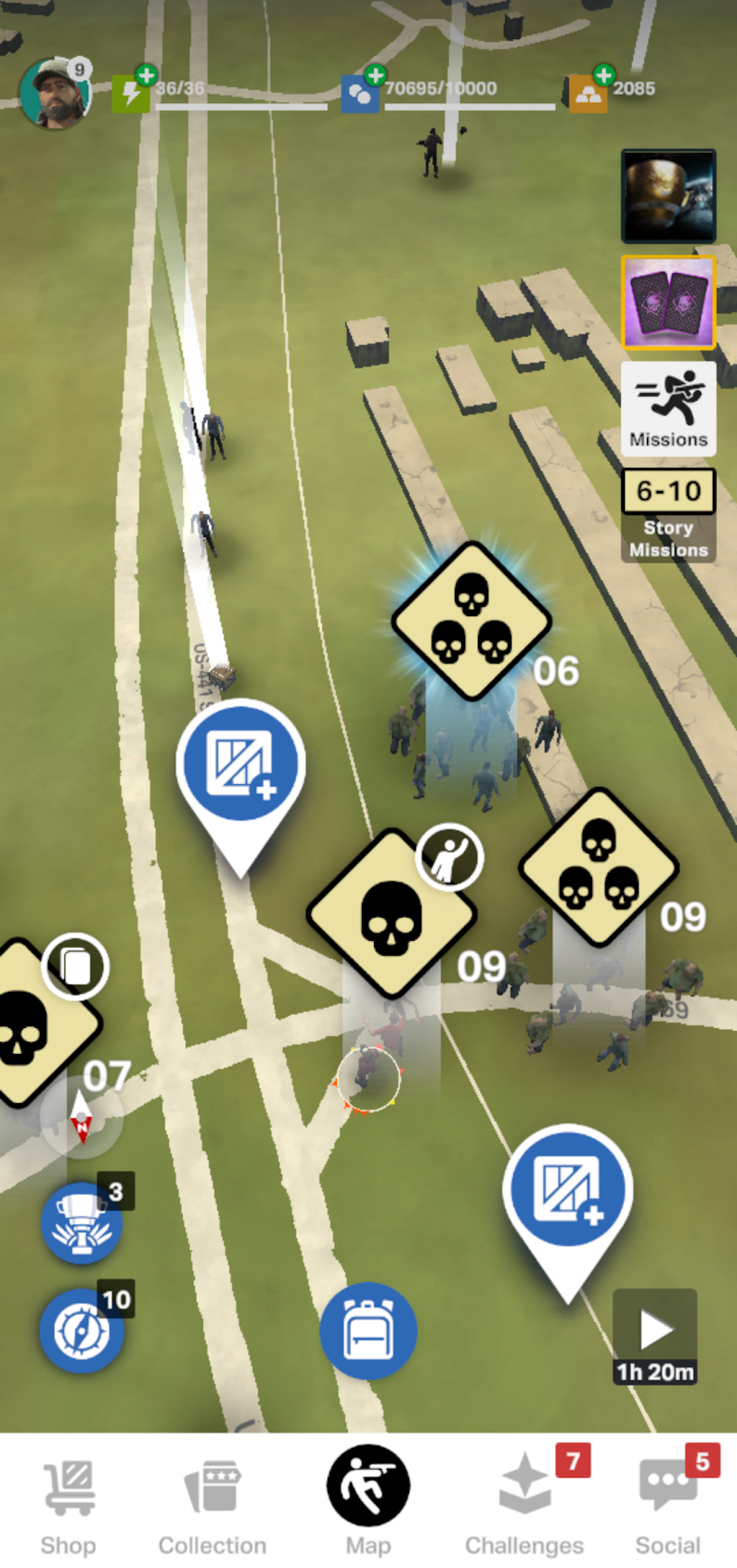
This is what a street near me looks like in game.  As you can see even out here in the boonies it's very well populated compared to Pokémon Go.  Most of the icons are different types of encounters I can try to take on, some with better rewards than others.  The blue crates will give me random supplies (usually energy or grenades).

What is the world like?  The game uses streets and buildings from google maps and adds zombie encounters to those.  If you get within 100 meters of most encounter types you can try to clear them if you are high enough level.  Players can also set up buildings (below) that grant you rewards if you help grow them by rescuing survivors and dropping them off.  In addition to randomly generated encounters, there is an extremely simple story line to play through.  Even out in the boonies, the density of encounters is pretty high.  There are five or six I can reach from my house, and plenty for an hour of play in my neighborhood.
An armory I set up near my house when I first started playing.  Whenever anyone drops off survivors, the base gets powered up a bit and then receives random cards for weapons in return (one card per survivor and base level).  Right now I have six days left to drop off enough survivors to take it up to level eight, or zombies will swarm it and destroy it.  Setting up these bases is one of the main ways you can control what kinds of upgrades you get.  They are completely random from most sources, yielding, an admixture of cards for perks, weapons and allies. Bases only ever grant cards of one of the three types.

Asynchronous interactions:  The primary way you affect the world for other players is setting up bases.  There are four different kinds you can set up, and a higher level base grants a decent chance at strong cards when you drop off rescued individuals.  If there isn't already one near you, it's advisable to build an armory that grants weapon upgrade cards when you first start playing.  Once you drop off enough rescued people for a base to go up one level, it will maintain itself for anywhere from nine days to several weeks depending on level.  However, if you don't level it up again before that timer runs down, eventually zombies will swarm it and destroy it.  Anyone that is playing can drop off NPCs at a base that you set up.  Eventually I will probably have at least two imaginary buildings in my yard for me and other players to use.  If you join a team, you can also work together with other players to clear a board that gives all of you really nice rewards.


The main way you play with others, apart from helping to upgrade random bases, is cooperating to clear boards like this one. It works like bingo, when you clear all the vertical and horizontal rows connected to a bag you can claim it.  The bags on these boards contain quite a bit of loot. Most of the objectives are things like "kill 150 zombies with grenades" that everyone in the entire team contributes to no matter where they are. 

How do you interact with other players?  The main way is by joining a team.  It's a lot like a typical MMO guild with different ranks and a chat channel.  Teams can hold up to 25 players, and getting into an active one is pretty essential to enjoying the game long term.  The main thing you do is work together to clear boards.  There are global rankings where different teams compete to clear boards as quickly as possible. It feels a lot like Conquest in SWTOR. The boards also grant very nice loot to everyone on the team as you clear them.  Each space on the board has a random requirement, like "drop off 70 survivors at an armory."  Everything done by team members contributes to the total.  You can also send up a flare that allows anyone on your team to teleport to your location, anywhere.  If there is a way to group up and fight together directly, I have not figured it out yet.   

I have been playing less than a week, and I already have a lot of characters I recognize from the show.  My wife is also a fan of the comics and says that these portraits resemble both the actors in the show and the comic book character designs.

Is it good exercise?  If you are playing in a place that at least has a few houses nearby, it hits the right balance better than anything I've tried.   Any given encounter you clear takes 30 minutes to respawn, so if you want to spend all your energy for the evening you really do need to get some walking in.  If you are lucky there might be enough to spend a third of your total near your house, you can't just sit in one spot.  However, the density of encounters is also high enough that you don't have to walk too far.  In my neighborhood, I can can play for about 40-50 minutes before I need to let my character rest.  By that time I will have cleared every nearby encounter I can easily handle, so there isn't a strong incentive to spend cash on the game. Walking around your neighborhood hoovering up humans, bringing them back to your base, and watching it grow is really rewarding. 

Saturday, August 28, 2021

A field guide to LBGs: Pokémon Go

Today I am kicking off my LBG Field Guide series with a game that is likely familiar, and so will form a useful point of reference for future posts, Pokémon Go. This is really the standard LBG against which most others are judged  right now, sort of like EQ in the early 2000s or WoW from about 2005 on in the MMORPG scene.  It is also supposedly one of the most profitable games on the planet, with a staggering 166 million users and more than a billion in revenue in 2020.  As a point of reference, only eight countries in the world have a larger population than Pokémon Go.  Next week I'll continue this series with a game that has a very different tone (to put it mildly), Walking Dead: Our World.  

Pokémon Go

What do you do?  The basic gameplay loop of Pokémon Go is to catch random pokémon.  You can play it entirely as a collector, just trying to get as many species as possible.  For this approach rare variants called "shinies" that have a slightly different appearance from the base specimens are highly sought after.  You can also play it as more of  simple RPG, looking for the pokémon with the best statistics and attacks for either group PvE (taking down raid bosses),  PvP battles with other players, or attacking and defending gyms. You have to pick which of three global teams, Instinct, Mystic or Valor,  that you will associate yourself with when you start playing. 

Pokemon Go for an active player in the country.  This is what my street looks like when I fire up the game.  We live in the boonies, so there isn't a heck of a lot around.  However, the game has also figured out that there are two very active players at this location so it has made my yard an active spawn point. Besides that random handful of pokémon, a hot air balloon with a member of Team Rocket (NPC bad guys) that I can challenge to a duel comes by about once an hour.  Sometimes random presents from advertisers also arrive by balloon.   

What is the world like?  In addition to  random pokémon wandering all around you, the game adds Stops and Gyms to the world.  A Stop is an area with a disk that you can spin every five minutes for random items (e.g., balls that you use to catch pokémon, potions to heal your pokemon).  Gyms are buildings that can also be used to get supplies of items like a stop, but primarily are the focus of asynchronous PvP battles.  They are also the areas where raid bosses, which often require teams of players to take down, can be challenged.

This is what the game looks like if you play in a more public area.  You can see a stop and three gyms in the background, as well as a new pokémon species that was recently released.

Asynchronous interactions: Gym battles. If a gym is held by a players of a different team, you can fight the pokémon in the gym to take it over.  It can take a while to defeat everyone in a gym that has a really good defensive team, but it is quite doable even with fairly weak pokémon.  The exception to this is if owners of the pokémon defending the gym are actively healing them as you fight.  A determined defender with a lot of resources can hold you off, but this is extremely rare. 

The primary asynchronous interactions focus on gyms.  This one is being guarded by two pokémon, including a Garbodor (the evolved form of Trubbish, below).  I could fight them, knock them out of the gym and place a pokémon of my own in the gym. That would bring me a few coins if members of my team are able to hold the gym long enough. A more friendly interaction involves presents.  You can send and receive presents from anyone on your friends list once every 24 hours.

If a gym is held by a member of your team, or if you clear it of defenders yourself, you can add a pokémon to the gym.  If the gym is held by your team long enough, you will get up to 50 coins for the game's currency as a reward.   The reason that determined defense of a gym is so rare, is that the reward maxes out at 50 coins after a few hours.  After that, there is no in game reward for holding the gym any longer.  This ensures a pretty steady turnover of gym ownership.

Far and away the main thing you do is catch and manage pokémon.  Here I am trying to catch a Trubbish, the trashbag pokémon, one of the newer designs.

How do you interact with other players?  Primarily you either challenge other players to PvP battles where your pokémon fight, or you group up with other players to take down raid bosses.  Both of these activities can be undertaken either with players that you are hanging out with in real life, or remotely with players that are on your friends list.  Until very recently it was only possible to participate in a raid if you were physically standing near the same gym.  However, this year the game added remote raid passes, which allow you to join a raid from any distance if someone on your friends list invites you, or to join random pick up groups that are fighting raid bosses within roughly a quarter mile radius of your current location.  You can also send presents to players on your friends list once per day.  When opened, a present grants a random supply of consumable items, much like spinning a stop.

If you are playing purely as a collector, shiny pokémon are the ultimate prize.  They are rare variants of normal species that have a slightly different coloration.  Here is my shiny Trubbish I caught in my front yard one day.  She is more black instead of the olive green of most Trubbish.  Some of the super rare ones can even sell for a bit of cash on the pokémon black market (because of course some people take the game too seriously . . .)

Is it good exercise?  It depends.  If you are in an urban area with lots of stops and gyms, walking around to spin them for goodies and to look for new pokémon is really helpful.  However, if you are out in the country, in many areas there are no stops and no gyms.  In these locations, it doesn't make much difference whether you walk around or not.  Pokémon will generally only spawn if you are burning incense, and that works almost as well sitting on your couch as it does walking around.  When I lived on the city I got a lot of exercise walking from the game.  Now that I live in a rural area, I get very little exercise from it unless I decide to go into town.